Green Same-Day Delivery in 2026: Six Questions to Ask Before You Book
Every courier website in the UK now has a green section. Leaves in the logo, a line about "sustainable logistics," maybe a percentage next to the word "fleet." Very few of them explain what any of it actually means — and if you're the person signing off on a supplier, that vagueness is your problem, not theirs.
This is a practical guide to interrogating a same-day courier's environmental claims. We've included what we do at Send It Direct, including the parts that aren't flattering.
Same-day delivery has an emissions problem
Let's start with the uncomfortable bit, because any article that skips it isn't worth reading.
Same-day courier work is, per consignment, among the least efficient forms of road freight there is. A standard parcel network consolidates hundreds of items onto one multi-drop route. A dedicated same-day job puts one vehicle on the road for one customer, often at short notice, frequently returning empty. That is the trade-off you're buying when a deadline genuinely matters — and it is a real trade-off, not a rounding error.
So when a same-day operator implies its service is inherently green, be sceptical. What a good operator can honestly offer is this: fewer wasted miles, right-sized vehicles, honest measurement, and credible action on the emissions that remain. That's the standard the questions below are built around.
The six questions
1. "Carbon neutral" — neutral how, exactly?
There's a meaningful difference between reducing emissions and compensating for them. Most couriers advertising carbon-neutral delivery are doing the second. That isn't automatically greenwashing — but you should know which you're being sold, and any supplier worth using will tell you plainly.
Ask: are you reducing emissions at source, offsetting them, or both? What proportion is each?
2. What's actually being measured?
"Carbon neutral delivery" can mean the road miles of your consignment, or it can quietly mean the company's office electricity. Scope matters enormously.
Ask whether the figure covers road emissions on your job specifically, and what data it's calculated from. The UK government's greenhouse gas conversion factors are the standard reference for this in the UK — updated annually by DESNZ, and the basis on which any credible UK operator should be calculating vehicle emissions. If your courier can't tell you what methodology sits behind their number, the number isn't worth much.
3. Is the offsetting credible, or is it a line item?
Carbon offsetting has a deservedly patchy reputation. The distinction that matters is between cheap avoidance credits of questionable additionality and structured mitigation with real standards behind it.
The framework to know here is Beyond Value Chain Mitigation (BVCM) — the Science Based Targets initiative's term for investment in emissions reduction or removal outside your own operations. The SBTi is explicit that BVCM is not a substitute for cutting emissions in your own value chain; it's what a company does about the emissions it can't yet eliminate. That framing is the honest one, and it's the one to listen for.
Send It Direct has offset all road emissions through BVCM since 2025. We'd rather describe it in those terms than claim our vans are somehow emissions-free.
4. Are you being sold a bigger vehicle than the job needs?
This is the least glamorous question on the list and probably the highest-impact one. A single item moved in a 3.5-tonne Luton because that's what was free is a straightforward waste of fuel and your money.
Ask how vehicles are allocated. Ask whether routing is done by a human guessing or by a system. Our same-day service uses tech-enabled routing to match the right vehicle to the consignment and put a driver on site anywhere nationwide within 45 minutes — the routing exists for cost and reliability reasons, but the emissions benefit is the same benefit.
5. What happens on the return leg?
Empty running is the quiet inefficiency in urgent freight. A van that delivers in Leeds and drives back to Bristol with nothing in it has doubled the mileage of your job for no output at all.
Ask what proportion of return legs carry a load, and whether the operator actively matches backloads. Also ask the scheduling question: if your consignment doesn't truly need to move within the hour, a timed delivery booked with some notice gives any courier far more room to plan an efficient route. Booking urgently when you didn't need to is an emissions decision as much as a cost one.
6. Can you prove it?
Tree-planting programmes, offset certificates, and carbon reports vary wildly in rigour. Ask for documentation you could put in front of your own procurement or ESG reporting. If a supplier's green claim can't survive being written down, it shouldn't survive your shortlist either.
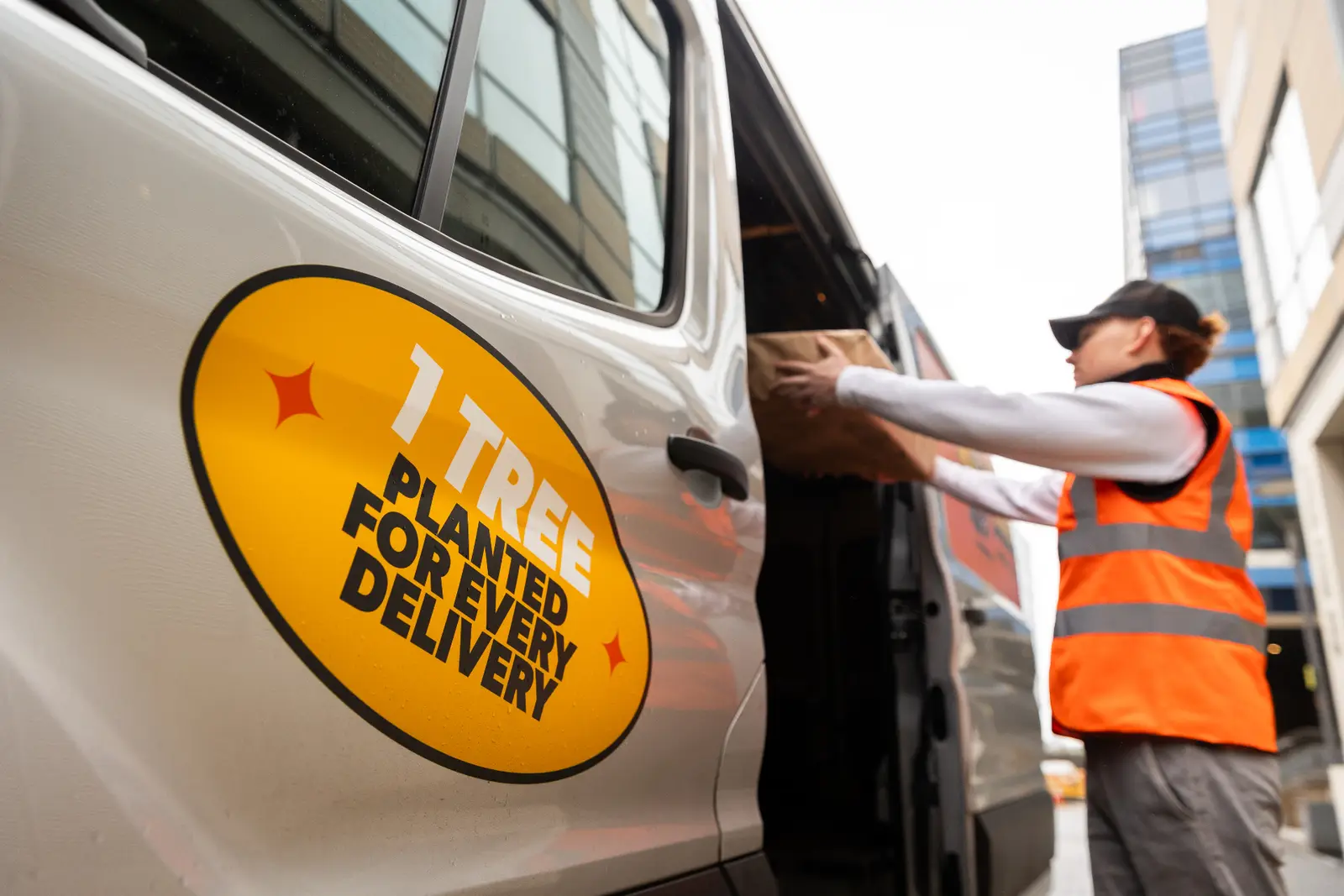
For the record: we plant one tree for every booking. It's a genuine commitment and our customers like it — but it's a contribution, not a carbon calculation, and we don't present it as one.
What this means for your own reporting
If your business reports on Scope 3 emissions, your courier spend sits inside that boundary. Which means a supplier who can hand you clean, methodology-backed numbers saves your finance or ESG team real work, and a supplier who can only hand you a leaf logo creates work.
That's increasingly where the commercial argument lands. Sustainability in logistics stopped being a marketing exercise the moment it started appearing in tender documents and customer reporting requirements.
A reasonable position
Nobody should tell you that urgent, dedicated, same-day courier work is a low-carbon activity. It isn't. What it can be is measured, minimised, and accounted for — the right vehicle, planned properly, with the residual emissions taken seriously rather than decorated.
If you'd like to see the numbers behind our carbon-neutral claim, or talk through how your delivery patterns could be scheduled more efficiently, get an instant quote or call the team on 0117 454 4144. We'll give you straight answers to all six of the questions above — including the ones where the answer is "that's the trade-off."
Frequently asked questions
What does carbon neutral delivery actually mean?+
It usually means emissions have been compensated for rather than eliminated. Ask your courier what proportion is reduced at source and what proportion is offset, and on what methodology the figure is calculated.
How should a UK courier calculate delivery emissions?+
Credible UK operators calculate vehicle emissions using the UK government greenhouse gas conversion factors, updated annually by DESNZ. Ask whether the figure covers the road emissions of your specific job.
Is carbon offsetting credible for courier deliveries?+
It depends on the standard behind it. Beyond Value Chain Mitigation (BVCM), as defined by the Science Based Targets initiative, is structured investment in emissions reduction outside your own operations — and is not a substitute for cutting emissions at source.
Does vehicle size affect delivery emissions?+
Significantly. Moving a single item in a 3.5-tonne Luton because it was the vehicle available wastes fuel and money. Ask how vehicles are allocated and whether routing is system-driven rather than manual.
Why does the return leg matter for courier emissions?+
Empty running doubles the mileage of a job for no output. Ask what proportion of return legs carry a load and whether the operator actively matches backloads. Booking a timed delivery with notice also allows more efficient routing.